Friday, December 1, 2023 (Court Day #612)
I left Santa Cruz about 10:40 a.m., headed north over the Santa Cruz Mountains, and arrived at the Sunnyvale Tennis Center in the Silicon Valley at 11:30 a.m. It was a slightly overcast but mostly sunny day with little to no breeze. Walking in, to be honest, I was anxious about getting dirty looks from tennis players as a pickleball usurper. I could see that there were some tennis games going on. But my concern was unnecessary, they had four permanent pickleball courts and another four that were dual striped on a tennis court.
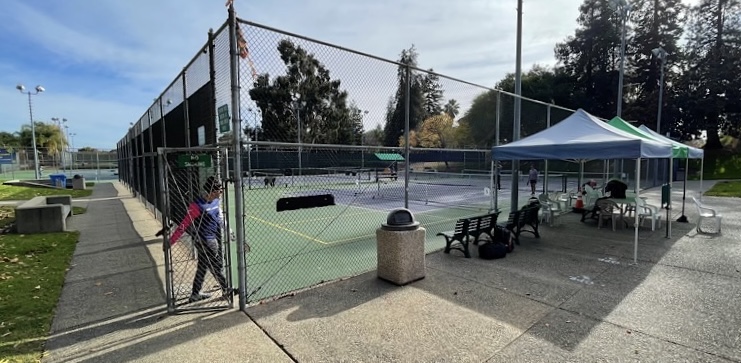
There were a few players hitting a ball back and forth on a pickleball court and one fellow standing next to a table outside those courts who appeared to be waiting for something. I wasn’t sure if he was the instructor or a tennis player or what. (Later, I learned that this was Ori, another PPR candidate.) Moments later, a large man walked up, dressed in a black polo shirt, and a black baseball cap. His name tag said Ali and his shirt and cap were embroidered with “PPR.” Ah! This was obviously our instructor! He asked if I was there for the certification program I confirmed “yes” and then he asked me my name. “Andrew.” We had a short conversation. Ali lives very close and was relishing his short commute. When I asked, Ali said there would be 13 people coming to his workshop.
Warming Up
The courts that were going to be holding the certification workshop upon were being used by unrelated pickleball players until our starting time of noon, so Ali had us warm up on the other dual-striped courts. We’d be joining the four that been there already.
I stepped onto an empty court and an older Korean man named Luc—pronounced just like “Luke”—walked over. He and I warmed up. Then a 20-something fellow named Ryan joined us. Ryan said he’d gone to Santa Clara University on a tennis scholarship. I asked if Santa Clara was a D2 or D3 program and Ryan told me that, in fact, it was a D1 program. Shortly after, a woman in a sporty skirt and outfit joined us. She appeared to be in her mid-50s and went by “Ad”, the abbreviation of her name. (Later, when I told her that I’m from Santa Cruz, she asked, “Do you know Jane Prince?” “Yes! I definitely know Jane.”)
Program Start
At noon, Ali announced that is time to move onto our reserved courts for the program. I’ll admit that I was a little anxious. I wasn’t sure what to expect. We all grabbed our things and moved onto the permanent dedicated pickleball courts. What was very impressive, was Ali had memorized all of our names by the start of the program. I think he may have forgotten one but it’s nonetheless quite a feat . . . and a goal for all instructors! (I will say, I greeted all eight of my parks & rec students by name at the second class a week after the first.) We had Luc, Ryan, “Ad” (Adriana), Lisa P., Lisa Z., Carrie, Kazuki, Amir, Oscar, Luke, Kevin, and Ori—and me, of course. Several candidates were instructors for Lifetime Activities (like Ali): Luke, Amir, Kevin and Oscar. (Ori is the pickleball pro at the newly opened The Hub in Alameda . . . which I didn’t even know existed until today! Ryan is also an instructor somewhere and his employers wanted him to get certified.
Games
Ali had us order ourselves into a line by birthday (disregarding the year). My birthday is during the summer, so I was in the middle of the line. He broke the line into three smaller groups of four, plus one extra person. Then Ali directed each foursome onto their own court to play doubles games to 5 points. Each group would play three games, and at the end, Ali wanted to know how many “stars” we achieved. Each game in which you were on the winning team would provide you a “star”. In the first round, I was partnered—in turn—with Ad, Luke, Amir. Amir didn’t win any games, so the rest of us all got two stars.
Since our court had finished our round of games first, Ali swapped out Amir for another professional tennis instructor, Kevin. This time Luke got three stars in the remaining players each got one. (Ali made the observation that there are only two mathematical possibilities: 3 players get 2 stars and 1 player gets 0 stars -or- 1 player get 3 stars and 3 players get 1 star. So, consider that two stars are awarded for each game, so for three games, six total stars are distributed over four players. It wasn’t discussed, but the only way to further evaluate players by results alone would be to either add more rotations or to take score differentials into account.)
This was all with the intent of judging how well we play . . . this was the skill level evaluation portion of the workshop, obviously. I didn’t keep track of him at all, but Ali must have been watching the games on the three courts.
Introductions
Once done with the games, we gathered up and then went through introductions. Each person gave their name, their pickleball background, and their coaching background. When I said that I’ve been playing for seven years, there is an audible reaction from the group indicating that they were impressed with that length of time. Ali had also asked about any injuries or medical conditions we were dealing with. I shared that I’d had knee surgery in June and was very recently working my way back onto the courts.

It was a diverse group in terms of experience. One woman had been playing pickleball for only a year, Lisa Z. There was a very experienced tennis coach who had been playing pickleball for a week, Amir. Luc had been a pro badminton player and coach in Korea. And though I didn’t know it at the time, also in the group was a 6.0 rated pro level player, that is, Ryan. (I later looked up Ryan and found a video of Ryan and his partner playing against the Johns brothers!)
Coaching Advice
After the introductions, we took a quick bathroom and water break, then Ali launched into a wide range of assorted advice based on his experience as a coach. This ranged from making sure to learn your students’ names to having plastic cone targets to use for drilling.
He suggested attaching value to good behavior such as providing points in a game. He mentioned “live ball coaching” vs. “fed ball coaching”. He suggested variety in warm ups and variety in drills. This went on for a couple of hours.
Occasionally, one of us would throw out our own helpful tidbits. I think it was Luke who shared that pyramid targets (three balls as a base, one on top) are great for kids since they “explode” when hit and they get really excited. But Ali did nearly all the talking.
This by far was the main thrust of the day. While some candidates sat, there was a fair amount of standing around and listening. And that was fine, it was all valuable information. I stood the entire time, though I moved into what little sun there was peeking through the trees. Regardless, it was worth standing in the chill . . . I was one of only two candidates wearing shorts at that point. And I was the only one without long sleeves available—my typical pickleball attire had some shortcomings!

Live Coaching Evaluation
The last portion of the afternoon, around 4 p.m., was our individual live coaching evaluations. This, by far, was the most stressful part of the experience. We were given the opportunity to pick a skill we wanted to coach for the evaluation. Given the number of people and the limited amount of time, Ali had three live coaching sessions going on at the same time. On three courts, there were two groups of four and one group of five. Ali moved from court to court observing and asking questions of the “students” about the “coach”—did he do this? what did he do about that?—and making notes. All of us were nervous about being evaluated, but we did fine.
It was starting to get dark. Ryan had to leave right at 5 p.m. and he was done with his coaching evaluation, so Ali shifted Amir from the group of five to our group. We stopped and did a quick group photo before Ryan departed.
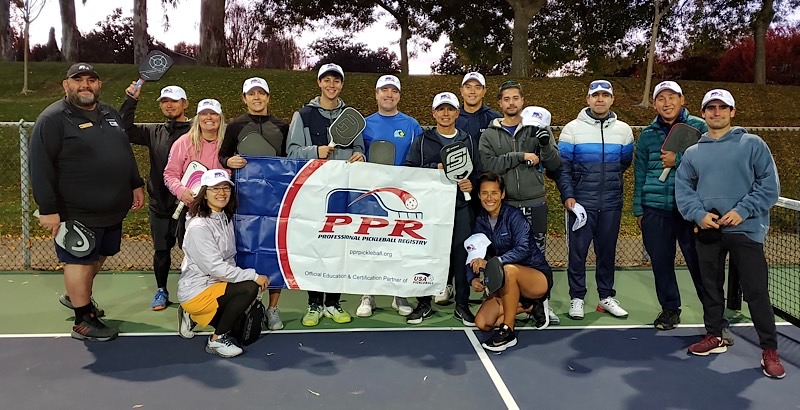
Nearly everyone was gone by 5:15 p.m. although a few of us—including me—volunteered to stay later and act as students for Amir’s evaluation. Amir did a fabulous job. His extensive professional coaching experience showed.
Overtime
After the official program concluded, one participant, Carrie, asked Ali about lobs. This was fortuitous, considering that one of my students had emailed me last night asking about lobs. The more perspectives on teaching something, the better. Carrie and I stuck around for about 20 minutes while Ali kindly explained, then demonstrated, how he’d teach defending lobs. Since our reservation had ended, we had to leave the court and we finished talking off to the side while Ali sorted his cones by color for storage. I said my goodbyes and Carrie and I left Ali alone to take care of his things. (We both offered help, but he turned us down . . . I’m sure he had a specific way and system of doing things.) Ali did share with us that we had all passed our coaching evaluations—that’s a relief!
Dinner Time!
It was 6:31 p.m. when I texted my son Nicholas that I was done and would be heading his way to join him for dinner in Santa Clara—Mongolian BBQ! It would be a relaxing change of pace after today. (And sadly, no, it didn’t quite live up to my memory of the last time I had Mongolian BBQ about 30 years ago!)
Number of days on a court: 612
Number of total hours: 2,681
Number of paid coaching hours: 5
To start at the beginning of this blog click on “1st Post” in the menu above.
Leave a Reply